What pre-1985 science fiction adventures have you finished this summer? Any great reads? Disappointing ones? Intriguing discoveries? Here’s the June installment of this column. I know, it’s been a while…
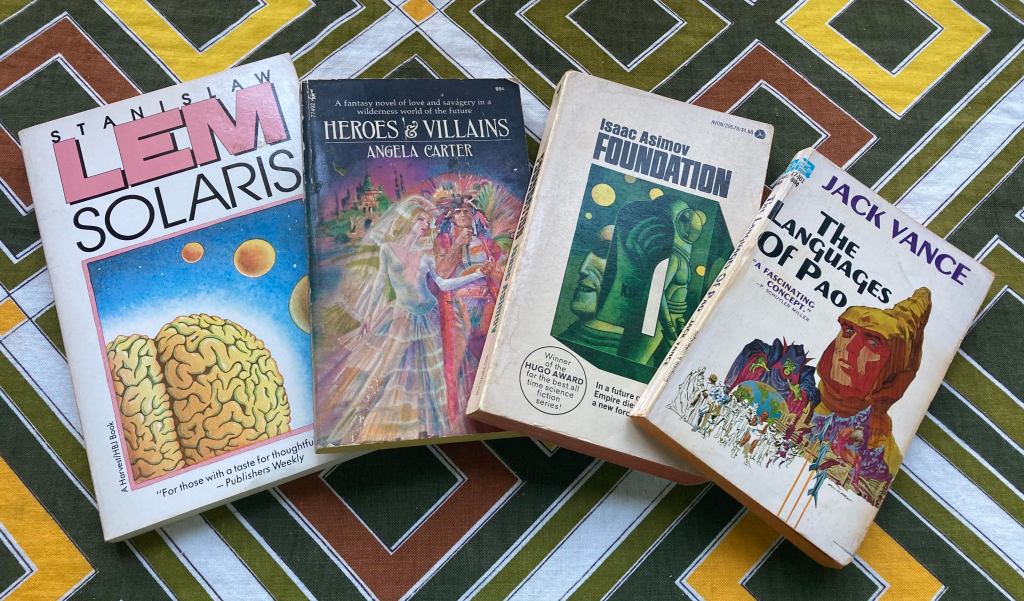
A selection of read volumes from my shelves
On Bluesky, a Youtube channel that I follow sought to collate a list influential cyberpunk novels for a future video or review series from the first generation of the subgenre’s practitioners. Other than Pat Cadigan’s multiple contributions, the list was entirely male. Knowing me, I suggested a few works by female authors that engaged with similar ideas that might be considered either important predecessors–for example Joan Vinge’s “Fireship” (1978) and Chelsea Quinn Yarbro’s Hyacinths (1983) (I think the proto-internet isn’t that central so it tends to be dismissed)–or works by the second generation right around the original poster’s cutoff date of 1990: Lisa Mason’s Arachne (1990), late 80s short fiction by Candas Jane Dorsey, Melissa Scott’s Trouble and Her Friends (1994), Gwyneth Jones’ Escape Plans (1986) and White Queen (1991), Misha’s Red Spider White Web (1990), and Nisi Shaw’s “I Was a Teenage Genetic Engineer” (1989).
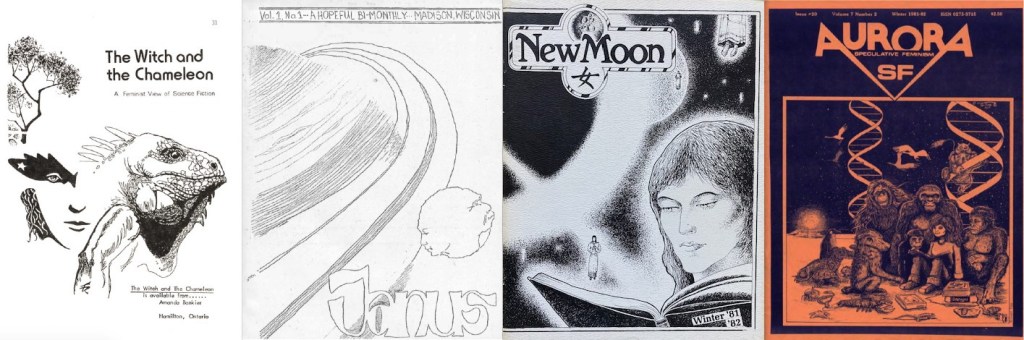
From L to R: The Witch and the Chameleon, no. 5/6 (1976), cover by Amanda Bankier; Janus, no. 1 (1975), cover by Jennifer Wilson, Jeanne Gomoll, and Janice Bogstad; New Moon (Winter 1981, 1982), cover by Robert Kellough; Aurora (Winter 1981), cover by Steven Fox
Over the last few years, I have curated a few pieces of science fiction scholarship in my Exploration Log series that I’ve found memorable, historically important, and worth sharing.1 Today I have an interview with SF scholar (and friend) Loïg J. F. Pascual, author of the recently published article “The Collective Memory of 1970s-1980s Feminist Science Fiction Fandoms: A Case in Reflexivity and Historiography for fan Studies Practices” (2026). The article appeared in Transformative Works and Cultures, Vol. 49 (2026) You can read a translated version in English and in the original French. The French version includes multiple Youtube video interviews with important figures in the movement.
More than just an interview about his specific area of research, Loïg dives into the larger history of feminist fanzines and the vital role of fan culture in the creation and memorialization of genre. Enjoy!
Graphic created by my father
1. Thank you so much for agreeing to this interview. Please introduce yourself and your interest in feminist SF fandoms in the 70s and 80s.
My name is Loïg J.F. Pascual, and I am a Ph.D. student at the Université du Québec À Montréal. I started reading science fiction (SF) with the books my father bought—collections of Philip K. Dick stories, Hard to Be a God (1964) by the Strugatsky brothers, and Robert Charles Wilson’s Spin (2005), Axis (2007), and Vortex (2007) series. We would spend hours looking for new SF reads in used bookstores.
Which books/covers/authors intrigue you? Which have you read? Disliked? Enjoyed?
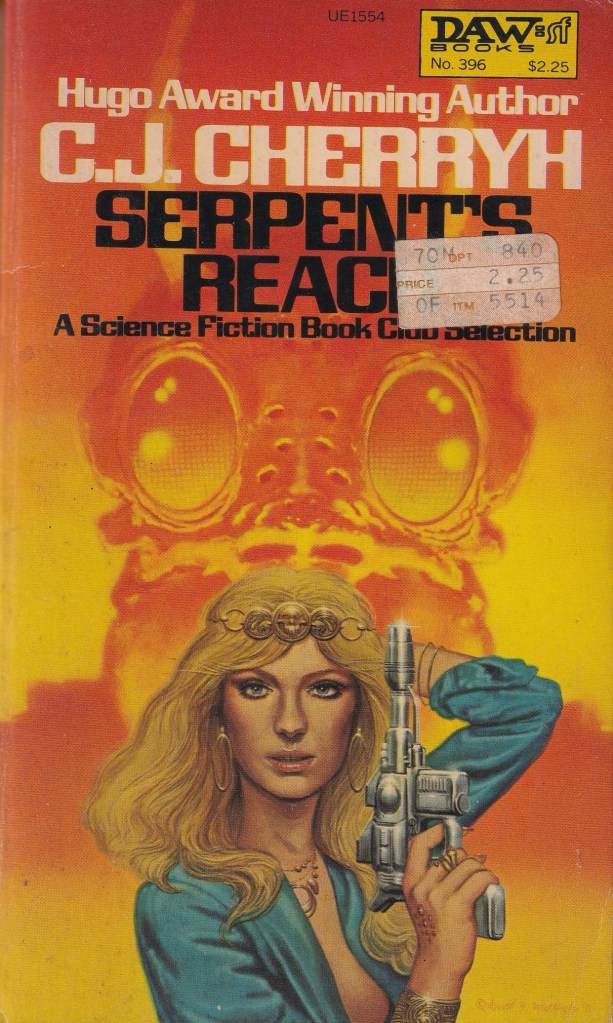
1. C. J. Cherryh’s Serpent’s Reach (1980)
David Mattingly’s cover for the 1980 paperback edition
From the back cover: “The constellation of Hydrus, known as the Serpent, is compact and obscure as seen from Earth’s sky. Even in the great era of interstellar colonization it remained obscure. For it was under strict quarantine – harboring an intelligent race, powerful, alien, and inhuman.
Yet there were human colonies within the Serpent’s Reach, cut off from the galaxy beyond, with their own inbred culture, their Families and traditions, and their special relationships to the inhuman majat.
This is the strange and brilliant novel of Raen, the last of the massacred Sul Family, and of her lifetime pledge to find vengeance. It was to take her across the worlds of the Reach into the very center of the alien webwork, into the strands of thought and counter-thought that knit the forbidden constellation into a complex of interbred cultures that no outsider could hope to unravel.”
Preliminary note: This review originally appeared in the second issue of Rachel S. Cordasco’s new magazine Small Planet: The SF in Translation Magazine. You can read the entire issue for free here! I plan on contributing one review of pre-1985 SFF in translation for each issue. In the first issue, I reviewed Knut Faldbakken’s harrowing dystopiaSweetwater (1976, trans. Joan Tate, 1994).
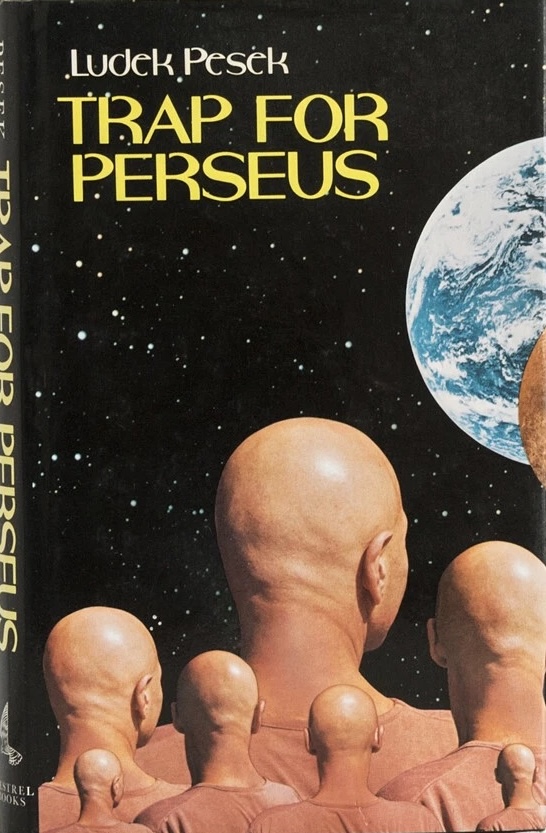
Jane R. Wattenberg’s cover for the 1980 edition
3.5/5 (Good)
Czech author Luděk Pešek (1919-1999), also a painter of space landscapes and photographer, emigrated to Switzerland with his wife in 1968. Due to his political beliefs and penchant to criticize the state in his early literary works, the Union of Czechoslovak Visual Artists expelled Pešek from its ranks. In Switzerland, he focused on painting space landscapes and providing illustrations for foreign publishing houses like Penguin Books and the National Geographic Society.1 He also wrote three science fiction novels in Czech, his native language: The Earth is Near (1970, trans. Anthea Bell, 1973), Flight into the World of Tomorrow (1975), and Trap for Perseus (1976, trans. Anthea Bell, 1980). All three first appeared in print in German translations.2 Anthea Bell translated two of the novels, The Earth is Near and Trap for Perseus, from German to English.3 I am unsure if the Czech manuscripts still exist. In the safety of exile, Pešek’s Trap for Perseus re-imagines the generation ship, so often a symbol of humanity’s technological triumph, as an isolated microcosm of Stalinist extremes detached entirely from its original purpose to colonize the stars.
The Lay of the Halls and Plantations and Other More Conceptual Places
Note: My read but “waiting to be reviewed pile” is growing. Short rumination/tangents/impressions are a way to get through the stack before my memory and will fades. My website partially serves as a record of what I have read and a memory palace for future projects. Stay tuned for more detailed and analytical reviews.
1. Tanith Lee’s Drinking Sapphire Wine (1977)
Don Maitz’ cover for the 1st edition
3.5/5 (Good)
In 2019, I read and mostly enjoyed Tanith Lee’s Don’t Bite the Sun (1976). The sequel Drinking Sapphire Wine (1977) follows the same nameless narrator of the first volume. It’s set in the same post-scarcity future replete with advanced technology where youth, the Jang, are encouraged (and “taught” via hypno-schools) to engage in all forms of excess. The narrator, sometimes female and other times male, attempts to find life’s purpose in a society without need. In cities surrounded by desert sand and the hidden ruins of ancient habitation, humans deploy technology to satiate all their whims. Society falls into three groups: The Jang, or the youth. In Limbo, new bodies are made for the Jang who commit suicide and others who want a change in costume or gender. Old People, the post-Jang state, are allowed to have children and pursue simple jobs (of course, backed up entirely by machines!). They too are able to change gender and create new bodies… The third and final “human” state are Quasi-Robots, who are humanoid androids and care for every human need.
Which books/covers/authors intrigue you? Which have you read? Disliked? Enjoyed?
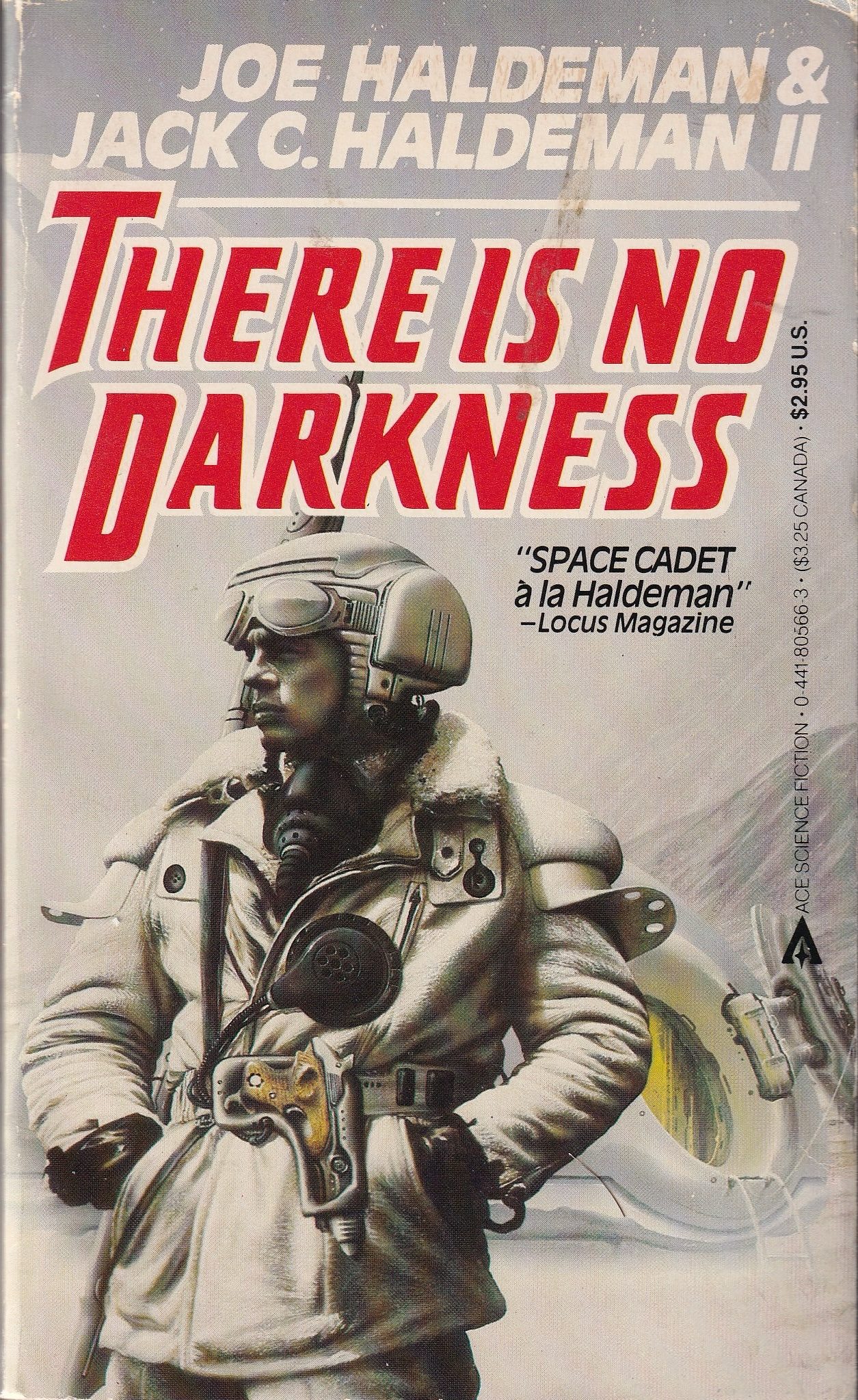
1. Joe Haldeman and Jack C. Haldeman II’s There is No Darkness (1983)
Jim Burns’ cover for the 1st edition
From the back cover: “The universe is not interested in fair play. The universe is interested in survival. That is lesson number one aboard the giant advance-training ship called ‘Starschool.’ Those who fail to learn lesson one very rarely have cause to worry about what comes next…”
Initial Thoughts: Even at his worst, I find Joe Haldeman a polished author. I’ve only read a few of his brother’s short stories. I’ve hear this volume is a bit on the juvenile SF side of things. We shall see.
Clifford D. Simak’s speech “The Face of Science Fiction” appeared in Minnesota Libraries, vol. XVII, no. 7. (September 1953). He originally gave it to the Minneapolis Branch Library staff. I have not found evidence that the speech appeared elsewhere or is anywhere online. I requested the article through the university library I’m affiliated with. I’ve included a transcription below. I hope with the easy access of important primary sources related to Simak’s fan activities and views on SF, we can see more scholarship on his fiction in the future vs. empty repetition of time-worn designators of his brand of SF.1 As with other posts on Simak’s interviews, speeches, and fan articles, I’ll provide a few words of summary first.
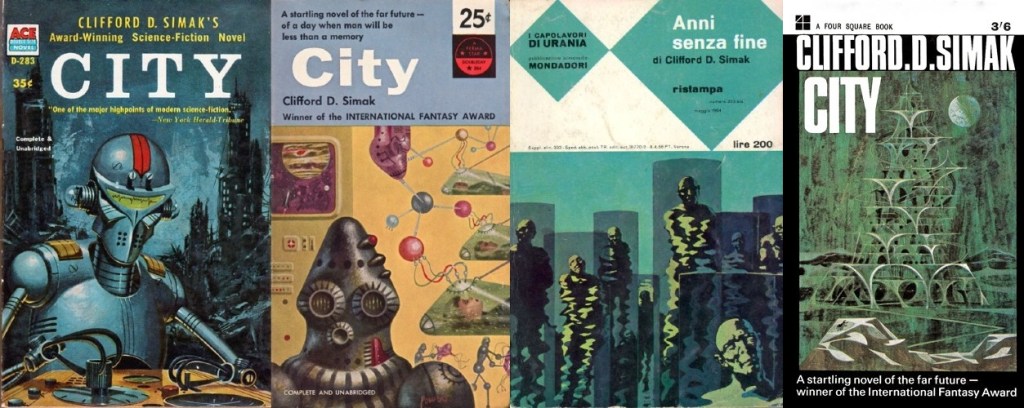
Four editions of Clifford D. Simak’s City (1952): Artists and publication date from L to R, Ed Valigursky (1958), Richard Powers (1954), Karel Thole (1964), uncredited (1965)
“The Face of Science Fiction” articulates the intersection of Simak’s own interest in the genre (and hope for its future), its larger history, with observations about the growing contemporary interest. He highlights the exploding popularity (and commercialism) the genre underwent in the 50s in the aftermath of WWII, for example the sheer quantity of magazines, toys, games, gadgets, and scientific gadgets designed with “science fiction motif” for teenagers. He charts his own exposure to the genre through authors like Jules Verne.
And echoing later arguments by Darko Suvin, posits an incredible “long and honorable lineage” of the genre with works like the Greek Legend of Icarus, Plato’s Republic, Thomas Moore’s Utopia, and Jonathan Swift’s Gulliver’s Travels that detach its origins from the influence of Hugo Gernsback (he does not mention his name but does acknowledge the “first science fiction magazines” that appeared in 1926).2 Arguments like this one partially serve as a rhetorical flourish meant to legitimize the genre and to self-justify your own brand of writing. And like those classics of old, 50s SF seems to re-manifest some of that ancient maturity (“fewer and fewer of them think of it in terms of Buck Rogers and rocket guns”) with increasing quality of writing. While acknowledging the fix-up novels still hitting print culled from the old pulps, he hopes the “backlog of old stories” is coming to its end.3 He admits that modern science fiction is still a young genre with growing to do!
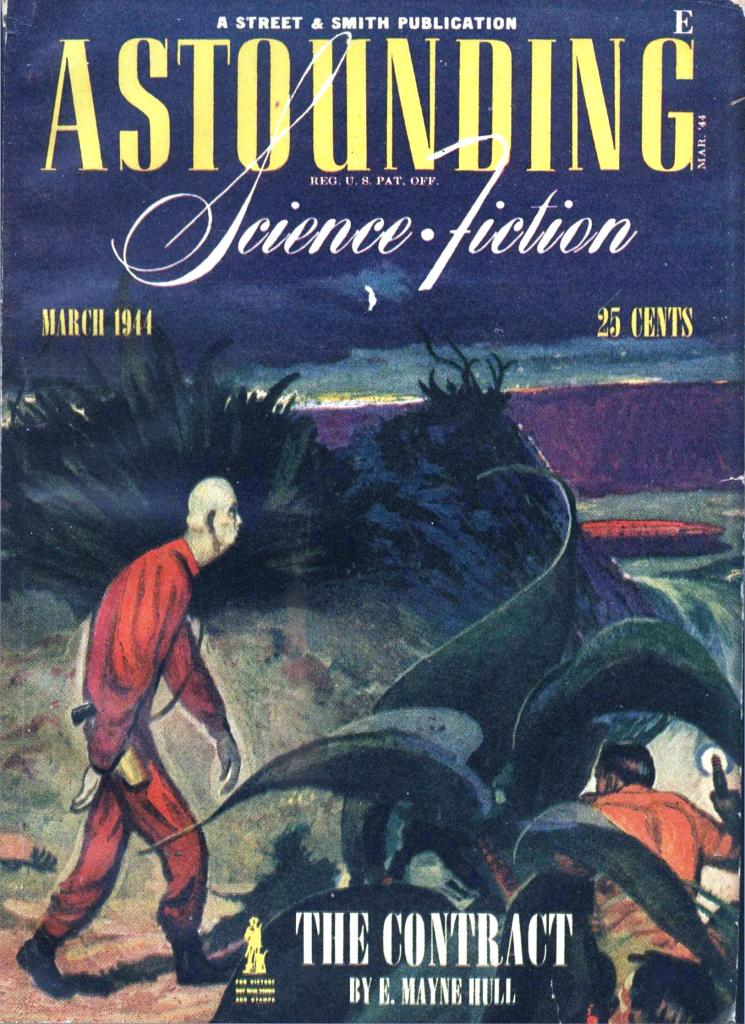
William Timmins’ cover art for Astounding Science Fiction, ed. John W. Cambell, Jr. (March 1944). Contains Cleve Cartmill’s “Deadline” (1944)
Note: My read but “waiting to be reviewed pile” is growing. Short rumination/tangents/impressions are a way to get through the stack before my memory and will fades. My website partially serves as a record of what I have read and a memory palace for future projects. Stay tuned for more detailed and analytical reviews.
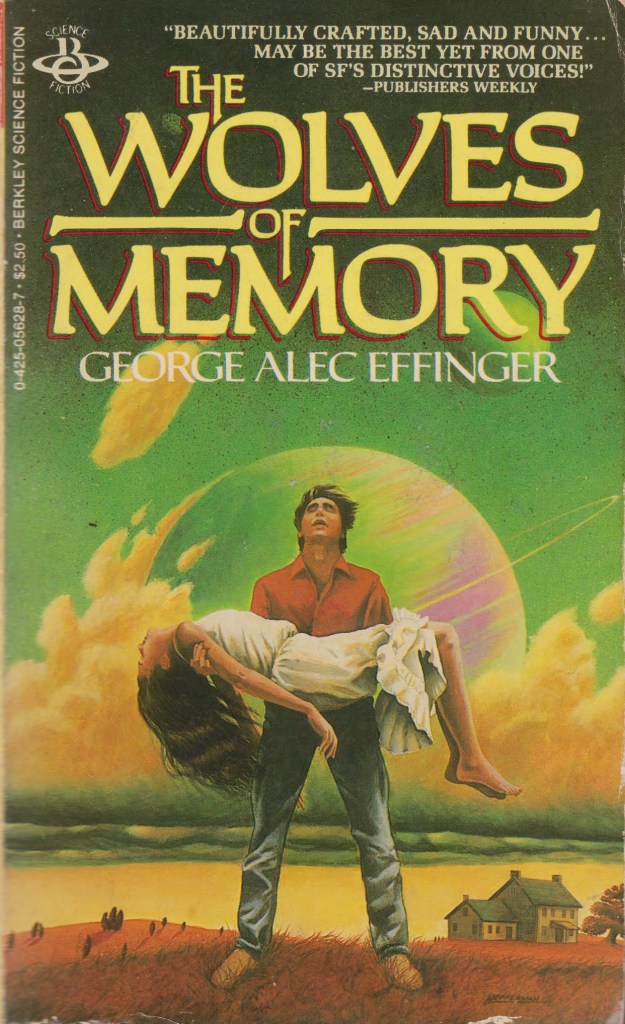
1. George Alec Effinger’s The Wolves of Memory (1981)
Norman Walker’s cover for the 1st edition
4.75/5 (Near Masterpiece)
I read almost 150 pages of George Alec Effinger’s masterful The Wolves of Memory (1981) before setting it down almost two years ago. As is often the case, I do not have a single reason why. It certainly had nothing to do with its quality. Perhaps Effinger’s uncanny evocation of dementia (through a SF lens) felt a bit too real. Perhaps his ability to render deeply affective interactions hurt in a way I rarely feel in science fiction. The volume sat on my desk waiting to be completed. I picked it up a few days days ago and finished in one sitting. I’m glad I did.
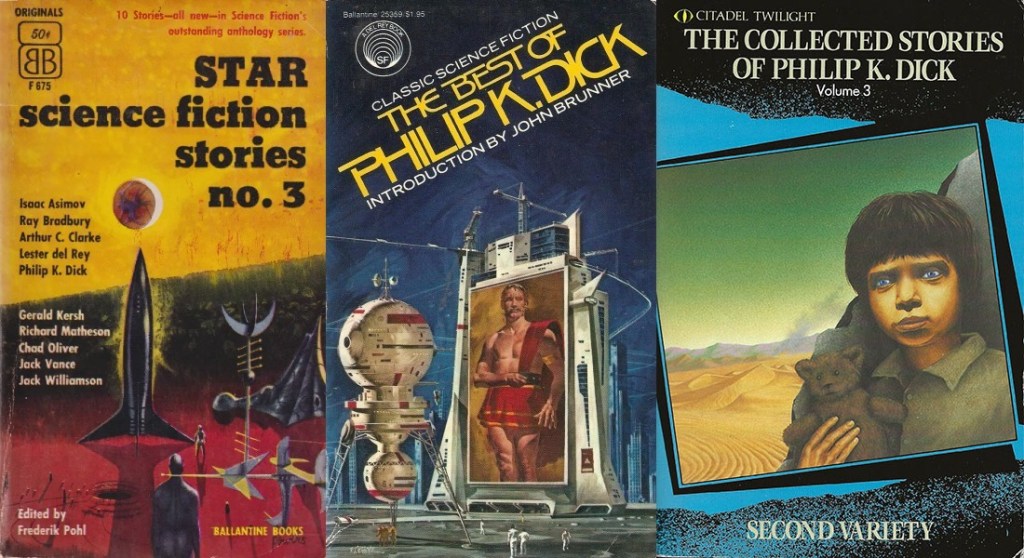
Three locations where Philip K. Dick’s “Foster, You’re Dead” (1955) appeared: L to R. Star Science Fiction No. 3 (1955), The Best Of Philip K. Dick (1977), and Second Variety (1991)
I appeared on the podcast DickHeads (i.e. Philip K. Dick fans) to discuss one of his most underrated (in my opinion) short fictions: “Foster, You’re Dead” (1955). If you want to read the short story before you listen to the quite detailed discussion, it’s available online here. I’m a sucker for science fiction satires of 50s American defense policy, commercialism, and the idiocracy of fallout shelters. As I am allergic to listening to myself, I’ve not given it a re-listen! Hopefully it went as well as I thought it did at the time.
Also, here is my short review of the story–part of my larger review of the entire original anthology Star Science Fiction No. 3, ed. Frederik Pohl (1955)–from last year if you don’t have time to listen to the podcast at the moment.